Gifted & Talented
Interested in the Gifted and Talented Program?
Would you like your scholar to take the CogAT test?
Scholars who have demonstrated the need for advanced programming by receiving differentiated instruction, by grasping concepts quickly, and needing additional depth, complexity, and/or creative expression, etc. may be referred to Gifted Identification.
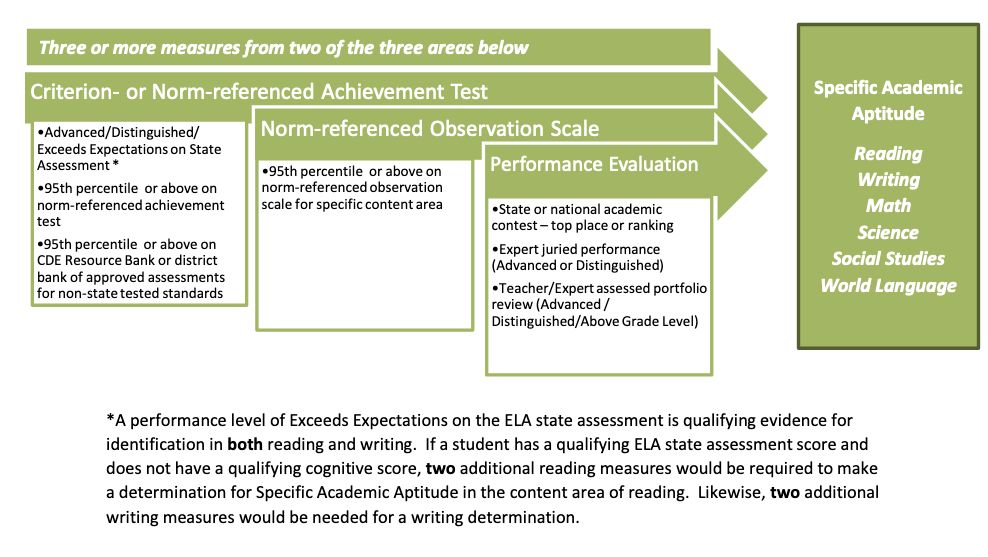
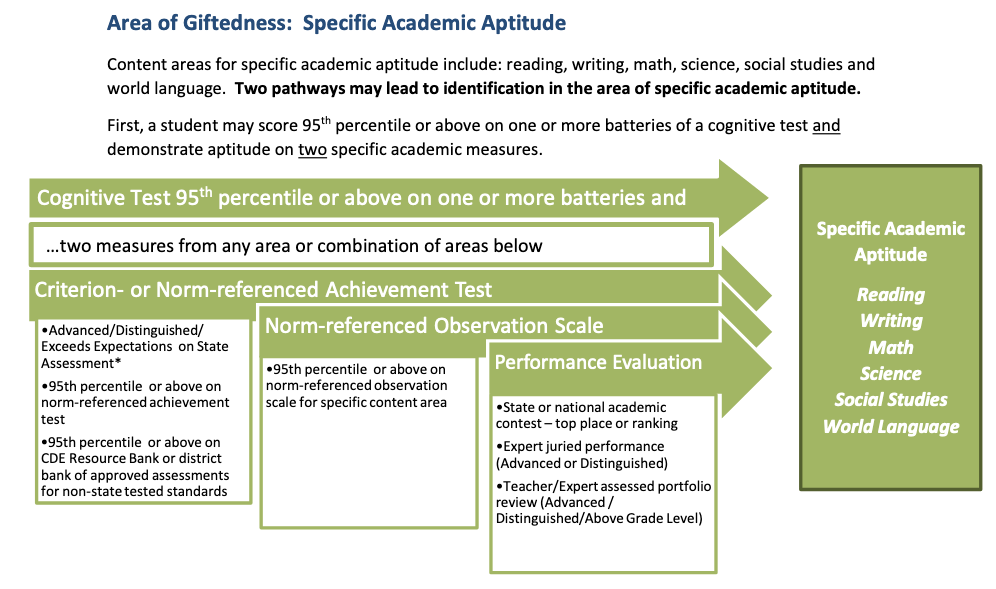
When identifying a student for gifted programming, the district looks for identifiers in four different areas: Aptitude (CogAT, WISC), Achievement (i-Ready, CMAS), Norm-referenced observation scale (SIGS completed by teachers), and performance evaluation (body of evidence to show advancement in specific academic, leadership or creative areas). Qualifiers, ranging in the 95 percentile, in three of the four areas are considered indication for being gifted and talented.
Referral testing takes place here at Leman, only during the stated DCSD CogAT window. Requesting this assessment automatically initiates the process to evaluate for Gifted Identification.
CogAT Testing
Dear Parents/Guardians,
DCSD is committed to implementing equitable practices to increase access to advanced/gifted learning opportunities. Based on state and national recommendations and requirements, we implement Universal Screening for students in 2nd grade (February) and 5th grade (November).
5th Grade Universal Screen
As part of this process, ALL students in 5th grade not identified for gifted programming will take the Cognitive Abilities Test (CogAT) the week of November 2, 2026. This assessment indicates the level and pattern of cognitive development of a student in comparison to grade and age mates. These general reasoning abilities, which start developing at birth and continue through early adulthood, are influenced by experiences gained both in and out of school.
Contact
To learn more about the Gifted and Talented program and identification please reach out to your campus contact:
Bayou Gulch:
Stroh:
If your child is already identified for gifted programming, they will not participate in this universal screen testing. Your Gifted Education Facilitator will contact you directly with information about this process.
Gifted Identification Referral Testing
If your child is in grades 3 and 4, and you believe they need evaluation for Gifted Identification and Services, you may refer your child for testing by initiating the Gifted Identification Process.
NOTE: Requesting this assessment automatically initiates the process to evaluate for Gifted Identification.
Please request CogAT testing for your child by completing the DCSD Gifted & Talented Referral Form.
Upon receipt of this form the Gifted Education Facilitator will connect with you to discuss next steps in the gifted identification process
Gifted and Talented Resources
Fostering the needs and desires of the Gifted and Talented takes a village indeed!
These unique scholars are surrounded by supportive teachers, innovative peers, and strategic gifted and talented coordinators who are eager to engage and fascinate your scholar’s amazing mind! Partnering with supportive parents to help cultivate their scholar’s mind is our ultimate goal in the Advanced Learning Program, so please use the links below to further your understanding of the gifted and talented program in DCSD.

This book is geared toward young gifted and talented readers; however, it is also a short and easy read for adults who would like to begin building a knowledge base about what it means to be GT. Judy Galbraith’s more than 20 years of experience working with the gifted community make this book a forthright and enlightening resource.
Reading this book can help young gifted children understand what the label gifted means to them. The author emphasizes how all individuals do not define their special talents or abilities the same way, and how specific talents and abilities differ from person to person. She addresses many questions floating through the heads of bright youth, and gives an array of educated answers to them. Gifted children can also benefit from some “been there, done that” experience of other gifted children in the “GTs speak out” segments featured in the book. The individual’s role in fully developing his or her high potential is highlighted throughout The Gifted Kids’ Survival Guide: For Ages 10 and Under with numerous tips on how to do so. Readers are also encouraged to write their own experiences or definitions pertaining to giftedness in designated sections. These are some of many aspects in this book that encourages gifted youth to increase their self awareness. The author also provides numerous “think about it” suggestions to assist with this. After reading this book, gifted children are likely to feel a sense of pride and empowerment related to their capabilities.

In addition, The Gifted Kids’ Survival Guide: For Ages 10 and Under could be a useful tool for parents who would like to empathize with their gifted child’s perspective. Reading the “GTs speak out” segments may help parents identify what their children are experiencing. Furthermore, knowing the tips on how to “make school more cool,” “how to be the best you can be” and more, can help parents teach their children to self advocate for their education. This book is written for a mature young population. There seems to be an assumption of high communication competency for the intended young audience. Discussing appropriate and effective means of self advocacy could be very beneficial to your child. The wise saying “you catch more flies with honey than vinegar” may be something parents want to explain to their children. Parents who read this book will be able to assist their children in understanding the “8 Great Rights of Gifted Kids,” and how to stick up for these rights in the most effective way. Other aspects of this book that may interest parents are the resources for parents and teachers, websites, and index found in the back of the book.
The Gifted Kids’ Survival Guide: For Ages 10 and Under is a book that can easily be read from cover to cover in one sitting. It is also a resource parents can lead their children to time and again to help them learn to handle difficult situations.
Support gifted teens with this one-of-a-kind book full of sage advice to help them understand themselves, relate well with others, and reach their potential in life. Based on new surveys of nearly 1,500 gifted teens, this updated classic is the ultimate guide to thriving in a world that doesn’t always support or understand high ability. Full of fresh illustrations, surprising facts, cutting-edge research, revealing quizzes and survey results, step-by-step strategies, inspiring teen quotes and stories, and insightful expert essays, the guide gives readers the tools they need to appreciate their giftedness as an asset and use it to make the most of who they are.
“This book provides gentle, straightforward, and realistic advice to teens who find that their giftedness is not always simple. The tone indicates quite clearly that the authors have a deep understanding of gifted minds and gifted children. Gifted young people everywhere should have access to this book, and the adults who work with them will gain a better understanding of them from it”
Gifted and Talented Forms
Gifted and Talented Identification Process
New to Leman and already have an Advanced Learning Plan?
Scholars coming to Leman Academy of Excellence from another district or state undergo a review of records process that will re-identify them into the gifted and talented program based on their cognitive and standardized test scores as well as a body of evidence collected from the scholar’s current teacher.
Definition of Gifted
Gifted and Talented students are those students between the ages of four and twenty-one whose abilities, talents, and potential for accomplishment are so exceptional or developmentally advanced that they require special provisions to meet their educational programming needs. Gifted students include students with disabilities (i.e. twice exceptional) and students with exceptional abilities or potential from all socio-economic and ethnic, cultural populations. Gifted students are capable of high performance, exceptional production, or exceptional learning behavior by virtue of any or a combination of these areas:
General Intellectual Ability Specific Academic Aptitudes
- Mathematics
- Reading
- Science
- Social Studies
- World Languages
- Writing
Specific Talent Aptitudes Creative or Productive Thinking
- Dance
- Leadership
- Music
- Performing Arts (theater, speech and debate)
- Visual Arts
- Psychomotor
Identification Process with Qualifying Cognitive Data
Identification Process Without Qualifying Cognitive Data